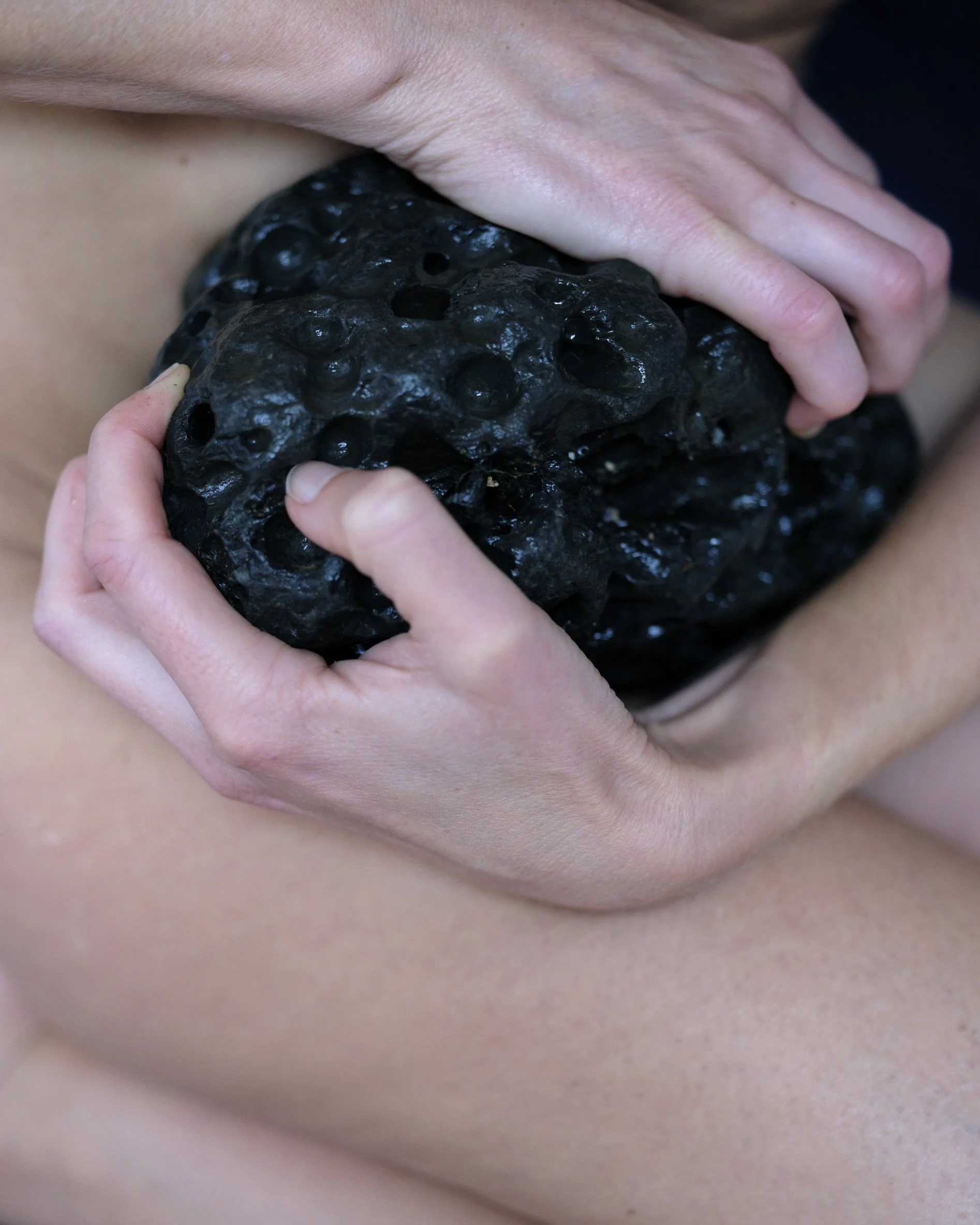
TOUCH/HUNGER
I read an article once which said that the conceptions we have about ourselves as discrete beings with clearly-defined edges are inaccurate. The atoms of our surfaces are actually in flux, shifting in the air, blending with it, and with each other. Nothing is solid, not really. We are porous, merging, drifting. The idea of a bounded self dissolves and falls apart.
I think about the distance between people, the gaps between bodies. How we fit together, nestle in for sleep. Big spoon, little spoon, in modern parlance. Head on arm or shoulder or chest. The way a knee slips between thighs, too heavy or just right. How we are the right temperature, how we share heat, dissipate cold.
The word nestle - so evocative, like to nest, to settle, to nurse, to rest on, with, against, in. Small touches, stroking skin, hair. Expansive ones, enclosing, reassuring, containing. The touches during the unconsciousness of sleep.
How we find each other’s soft parts, mould ourselves into comfortable contours, know which holds can last hours. Alert to the shapes that say leave me alone, I want space. Then we lie together but separate, conscious of the gap, of not transgressing it until we feel more certain that touch will be welcomed.
I like the gentle brushing and bumping of arms and shoulders when I walk next to the person I am in love with. It is a subconscious closeness, a breaching of the usual boundaries that with a different person would signify clumsiness or thoughtlessness. Not obvious to an onlooker, it is a felt relation of moving together through fleeting touches. I love it most when touching and being touched become casual, easy, frequent, and touch becomes part of the developing vocabulary with that person. I find it easy to love others. Sometimes it is as though I have a container of love inside me that might burst if I do not have recipients for it. Touching is a conductor. An earth.
Why do we think of attachment as something permanent? Why do constancy and immutability seem essential characteristics of it? Children and lovers share our lives for a time, maybe intensely and optimistically, but still for just a while. Should we only get attached to what we think will stay? How do we make sense of transience in our attachments? Should we not get attached at all? Buddhism tells us that attachment is the root of suffering, but maybe knowing secure attachment is a necessity insofar as it lets us learn how to let go. Do our attachments point to what has the most capacity to hurt us?
I am learning Irish. I feel that it is about time I did, but I am also fascinated by its connection to this land, to history, and to my mother. To become absorbed in something so bounded feels reassuring at a time in which horrifying things are happening in the world.
Irish is a language that expresses attachment in a way completely unlike English: there is no verb to have. You don’t possess anything; instead, it might be with you, or upon you, at, under, or between you. To express a need for something, you say it is away from you. Feelings are also subject to this nuanced distancing. You aren’t sad, rather sadness is upon you. There is a temporariness in this that points to the ephemerality of existence, of feelings, of situations, and of people. This new (to me) way to speak of attachment makes me slow down and reflect on our relations to others.
In Irish, as in French, to say ‘I miss you’ the subject and object are inverted.
You are missing from me.